



ReservationSearch and reserve rooms
Click here to confirm, change or cancel your reservation
Flight-Inclusive Packages
Shinkansen-Inclusive Hotel Packages
Corporate Partner Reservations
2025.09.20
A piece of paper that brings the aesthetic sense of the Heian period to life. Memories of travel woven with "Kyoto Karakami"
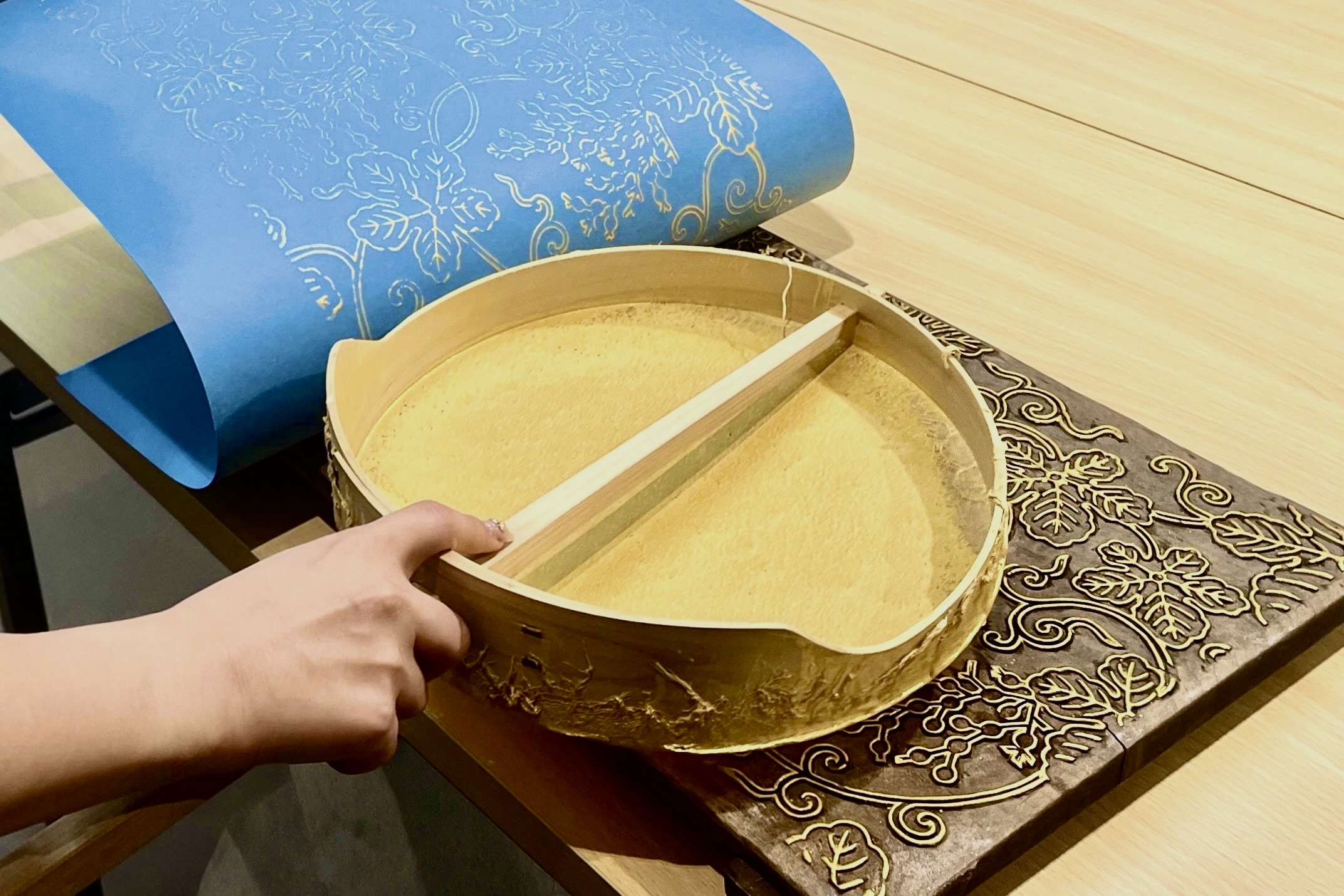
"Kyoto Karakami" is an elegant decorative paper that was introduced from China during the Nara period and was used by Heian aristocrats to compose waka poetry and writings. The delicate technique of applying patterns to each sheet of washi paper using a woodblock is still alive in Kyoto today, more than a thousand years later.
Maruni Co., Ltd., which was founded in 1902 (Meiji 35) as a mounter specializing in hanging scrolls and folding screens, continues to carry on this tradition. Today, the company handles Japanese interior materials such as sliding door paper and wallpaper, while continuing to preserve the techniques in its own workshop.
At Karamaru, Maruni's experience workshop and shop, you can learn about the history and aesthetic sense of Kyoto Karakami and actually print your own unique piece. Enjoy the moment when the pattern gently emerges on a piece of washi paper, and take it home as a memento of your trip.
From everyday consumables to traditional crafts
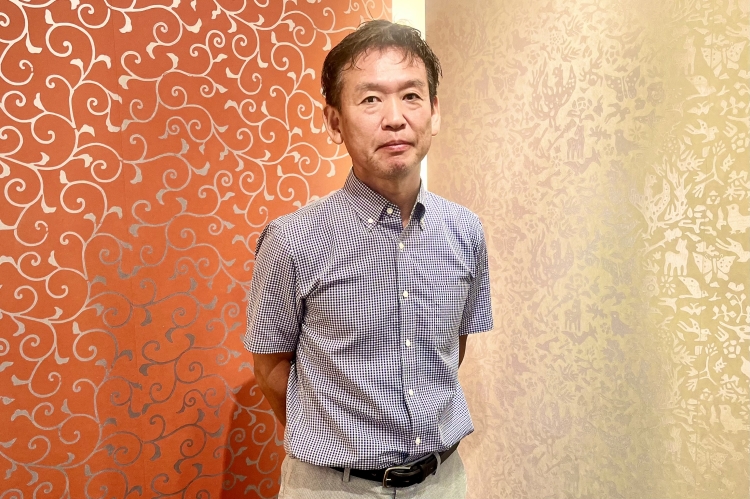
Mr. Nishimura, the CEO of Maruni Co., Ltd., conveys the appeal and potential of Kyo Karakami
"During the Edo period, sliding door paper was called karakami and was an essential consumable item for the everyday lives of ordinary people," says Kazunori Nishimura, the fourth generation owner of Maruni.
However, with the influx of printing technology after the Meiji period, karakami makers began to close one after another, putting the tradition of handcrafting at risk of extinction. In the midst of this, the woodblocks from the closures were passed on to other karakami makers who continued to preserve the tradition, and some of these are still treasured and used at Maruni today.
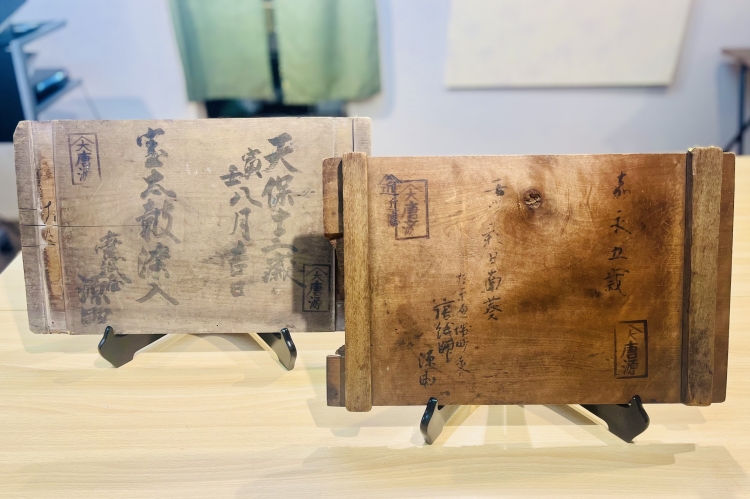
The backing of a working woodblock that has been passed down since the Edo period
Some woodblocks have been in use for over 180 years, dating back to the Edo period. On the back there is a "reverse note" that lists the year it was carved, the publisher's name, the name of the pattern, and more, allowing you to get a sense of the history that each woodblock has gone through.
Another attraction of Kyo Karakami is the rich expression that is created by the woodblocks that have aged over the years. "When a woodblock is used for many years, the corners of the pattern become rounded, and when it is rubbed, a unique softness is created," says Nishimura. This warm texture that cannot be expressed through printing is perhaps the essence of handcrafted work that has been preserved for generations.
Inheriting tradition and discovering new possibilities
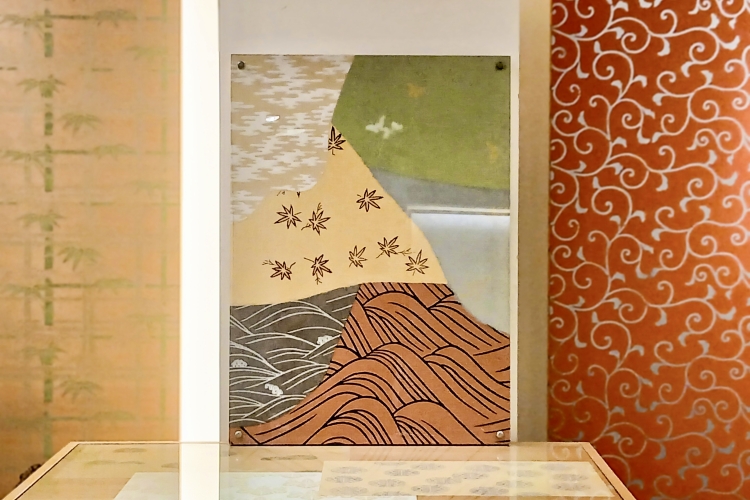
A panel of "Kyoto Karakami" left by Nishimura's grandfather
Nishimura says he had no intention of taking over the family business originally. The turning point came when he came across a panel left behind by his grandfather. He was captivated by the piece, which was made of Kyoto Karakami paper pasted together like a collage, saying, "It's old, but it's so stylish." He felt that it had limitless possibilities that are relevant to the modern day.
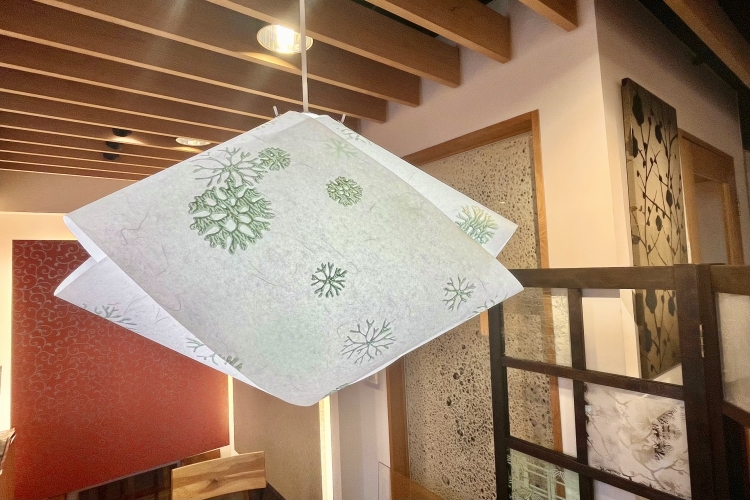
"KARA-IRO" is a pendant light with a pattern printed on special Japanese paper.
This passion is now driving Maruni's challenge, which is based on both tradition and innovation. In an era where the number of Japanese-style rooms is declining, the company is proposing Kyoto Karakami as wallpaper and art panels. Furthermore, the company has developed Urushi Karakami, which combines lacquer with the material, to create a presence that will stand up to the global market, and its progress never stops.
"I think the appeal of Kyoto Karakami is that it's easy to cook with."
It can be printed not only on paper but also on silk, and can be combined with various colors and patterns, allowing for a wide range of creative possibilities. Its uses are endless, from stationery to interior design and architecture.
A special travel book created with wishes in the patterns
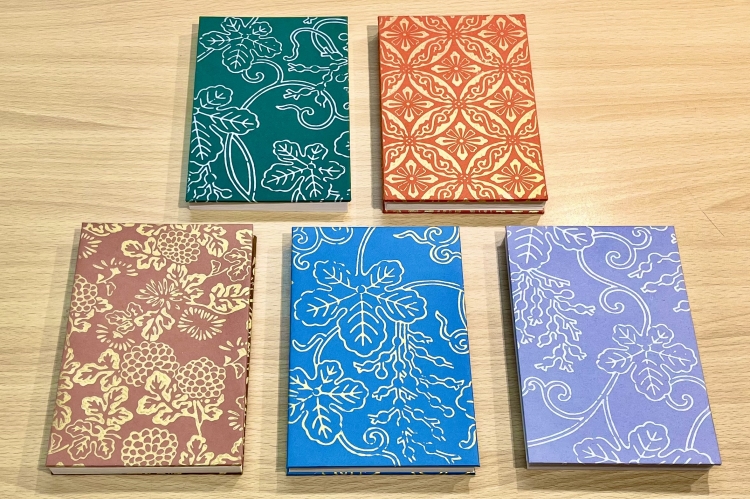
"We want to be an entry point for many people to learn about Kyo Karakami." This is the idea behind the creation of the experience workshop "Karamaru." In the popular "Goshuincho (stamp book) making experience," you can print your own Kyo Karakami and have it made into a one-of-a-kind goshuincho (stamp book).
The washi paper used is Echizen Torinoko paper, which is said to be a good match with Kyo Karakami paper due to its fine texture that beautifully reproduces intricate patterns. Choose a color that appeals to you from over 20 colors of Echizen Torinoko paper, and then choose your favorite pattern from three types of woodblocks that are prepared each month.
For example, the "grape arabesque" pattern represents fertility and prosperity of descendants, while the "small chrysanthemum" pattern represents health and longevity. The time spent thinking about these patterns is also a highlight of the experience.
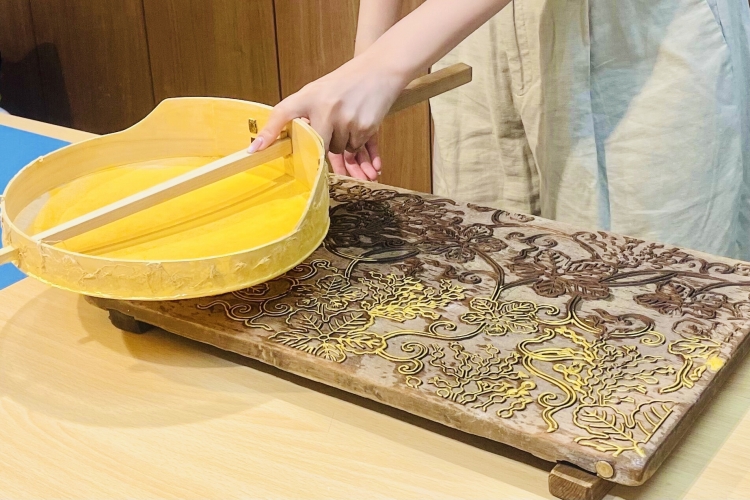
Sieving paint onto the woodblock of "Grape Arabesque"
The paints used are glittering mica, a powdered form of granite. The adhesive is made from boiled down funori seaweed. All of these are natural materials that have been passed down since ancient times.
The paint is applied to the woodblock using a sieve, and then the washi paper is gently placed on top, and the block is rubbed gently in a circular motion with the palm of the hand. By repeating this process twice, a unique, plump, and voluminous feel is created.
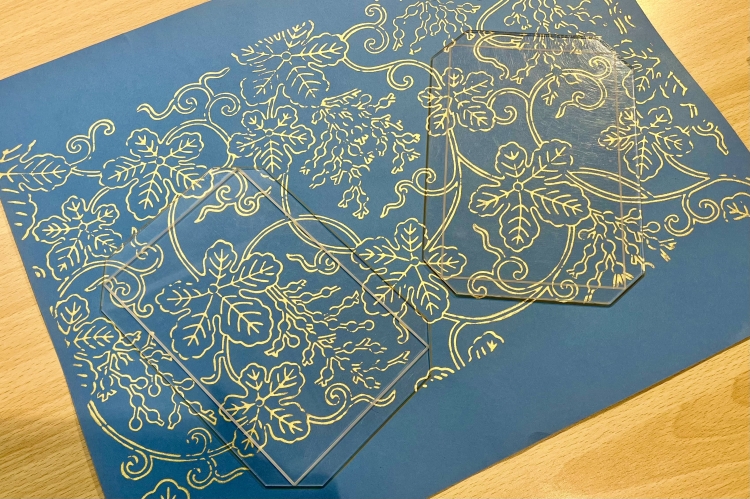
Cutting out the cover of the goshuincho to fit the frame
The part that will become the cover is cut out from the printed "Kyoto Karakami" and finished into a goshuincho. The pattern shows different expressions depending on where you cut out, allowing you to experience the depth of "Kyoto Karakami" and the fun of handmade items.
Karamaru also offers a wide range of hands-on courses, including interior panel and lighting shade making, and workshop tours, allowing you to experience the world of Kyoto Karakami from a variety of angles.
Add the beauty of "Kyoto Karakami" to your daily life
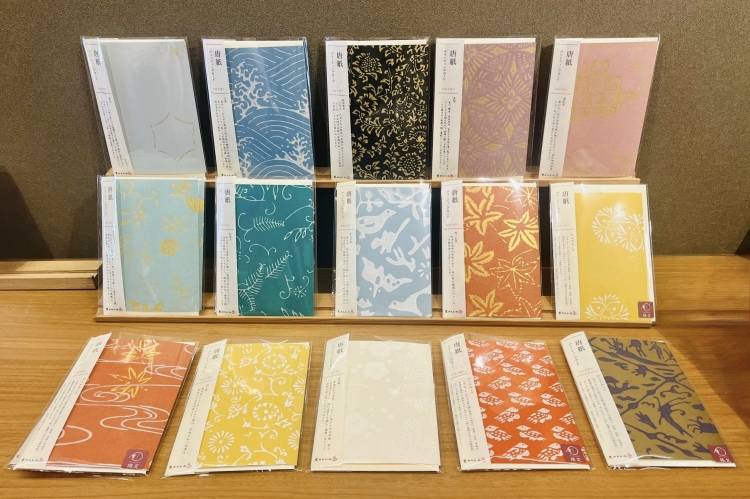
Karakami greeting cards with a variety of patterns
At the gift shop attached to Karamaru, you can purchase attractive products made with Kyoto Karakami.
The "Karakami Greeting Cards" are folded cards made from "Kyoto Karakami" paper that has been carefully hand-printed by artisans. It's fun to choose a design while thinking of the person you're giving it to, and they would also make a great addition to a seasonal letter or gift.
Also popular is the "Block Stamp Set," which includes wooden stamps and ink made from the same magnolia wood as the block. The adorable, one-point size stamps feature seasonal patterns such as "small gourds" and "flying cranes," making them perfect souvenirs and easy to enjoy in your daily life.
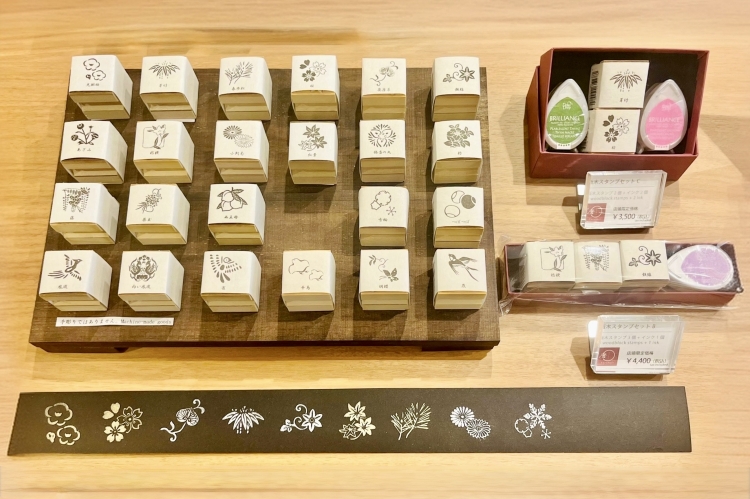
The "block stamp set" is a popular souvenir
Travel memories woven in the palm of your hand
Even today, "Kyoto Karakami" still radiates a vivid sense of beauty and potential. The experience of touching a part of this long story and printing a pattern on a woodblock that has been preserved and passed down is like traveling through time.
A piece you have created with your own hands will add color to your everyday life and bring back the excitement of your travels.
京からかみの体験工房とショップ 唐丸
電話:075-361-1324
住所:京都府京都市下京区泉正寺町460
アクセス:地下鉄烏丸線「四条駅」5番出口より徒歩5分
阪急「烏丸駅」15番出口より徒歩8分
HP:https://karamaru.kyoto
SNS:https://www.instagram.com/karamarukyoto
*営業時間や定休日についての詳細は、上記のリンク先からご確認ください。

HOTEL RESOL KYOTO KAWARAMACHI SANJOHOTEL RESOL KYOTO KAWARAMACHI SANJO
59-1 Kawaramachi-dori, Sanjo-sagaru, Daikokucho, Nagagyo-ku, Kyoto-shi, Kyoto 604-8031
TEL.075-255-9269
Only a 4-minute walk from Kyoto Shiyakusho-mae Station. Just a 1-minute walk to the Pontocho and Kiyamachi areas, where you can experience the atmosphere of Kyoto's traditional geisha district (Hanamachi).