ReservationSearch and reserve rooms
Click here to confirm, change or cancel your reservation
Flight-Inclusive Packages
Corporate Partner Reservations
2026.03.25
Experience painting unglazed ceramic dolls at "Hakata Doll Museum Shogetsudo".
NEIGHBORS
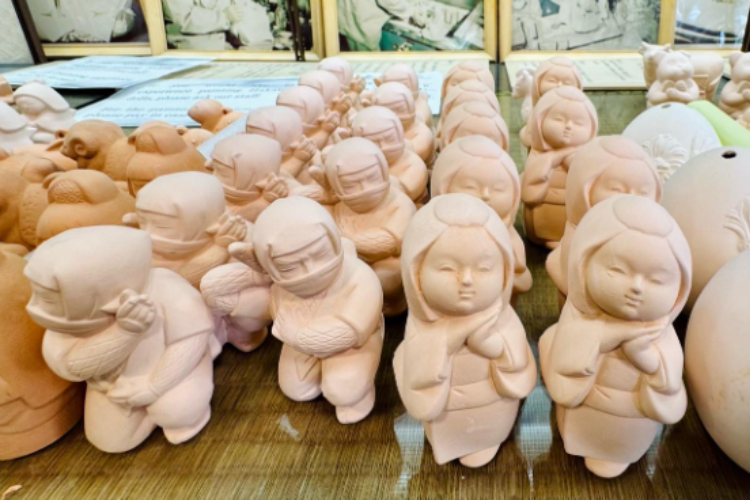
Unglazed Hakata dolls are quietly lined up in the shop. Their faces, still blank, seem to be waiting for expressions to be drawn upon them.
At the Hakata Doll Museum Shogetsudo in Nakasu, Fukuoka, you can experience painting Hakata dolls.
Hakata dolls are a representative traditional craft of Hakata, known for their warmth from the clay and beautiful expressions. It is said that the origin of Hakata dolls dates back to 1601 (Keicho 6), when Lord Kuroda Nagamasa built Fukuoka Maizuru Castle, and the third-generation tile craftsman, Masaki Soshichi, presented dolls to him. Today, various types of Hakata dolls are made, including beautiful women, children, Noh and Kabuki characters, warriors, and seasonal figures.
"The most important part is when you put in the eyes at the end."
As I pointed my brush at the doll placed in front of me, the representative, Yoshihiro Hiyama, kindly gave me instructions.
It all started with our connection with our customers.

Matsugetsudo Building, located along the Hakata River with a great view.
Hakata Ningyo Kaikan Shogetsudo was founded in 1947 (Showa 22) when the first generation owner, who was working as a confectioner at the shop, was suggested by a regular customer to "try handling Hakata dolls."
At that time, there were many visitors from overseas, and the products sold very well. Eventually, the business shifted its focus from confectionery to Hakata dolls, and it evolved into its current form.
Having taken over from his father nearly 30 years ago, Yoshihiro, the current owner who still works at the shop, says, "This shop started with a connection with our customers. From there, we have cherished the role of connecting artists with customers."
A collection of expressive dolls lined up together

The shop displays a collection of Hakata dolls, each with different expressions and styles.
The shop displays over 600 Hakata dolls. Works by nearly 50 artists, from young talents to master craftsmen, are all gathered in one place. Even dolls made from the same mold have no two expressions exactly alike.
According to Yoshihiro, "The face is the most difficult part. Even a slight difference can make it look completely different." He explains that the final steps, "coloring" and "facial expression," which involves drawing the facial features and imbuing the doll with soul, are what create that difference.

The store is spacious, measuring 85 tsubo (approximately 284 square meters).
Hakata dolls were once found in almost every home, representing various wishes and hopes. Over time, their appearance has also changed, shifting from large dolls to smaller, more easily displayed ones.
Although we may not encounter them as often in our daily lives as before, they continue to accompany people through important milestones such as birth celebrations, job transfers, and seasonal decorations.
The clay and handiwork that support Hakata dolls

Hakata dolls, featuring beautiful women, boast a soft, unglazed texture and delicate coloring.
Hakata dolls are unglazed earthenware dolls that express the softness and movement of kimonos using only clay, without the use of fabric.
According to Yoshihiro, "Whether the doll's skin turns out beautifully depends on the clay." If the clay isn't fine-grained, the surface will be rough, and a smooth expression won't be achieved. However, in recent years, the craftsmen who make this clay have been retiring due to old age, making it difficult to procure the materials.

Hakata dolls depicting warriors possess a powerful and impressive presence.
Many writers are in their 70s and 80s, and there is a continuing shortage of successors. Furthermore, creating high-quality works takes time, making it difficult to make a living.
"The variety of Hakata dolls we have on display in the shop has decreased considerably. There are quite a few series that are down to their last piece," says Yoshihiro, sounding a little sad.
However, even under such difficult circumstances, Hakata dolls have been passed down through generations, and each one is still carefully crafted today.
Experience the tension transmitted to the tip of the brush in a "painting experience."

I'm making progress with the coloring, using various techniques to overcome the unfamiliar task.
At "Hakata Doll Museum Shogetsudo," they offer a painting experience that can be done by one person or more, where you can freely color a bisque-fired doll of your choice with acrylic paints.
First, the kimono is colored. Depending on how much pressure is applied with the brush, the color can come out too dark, which can greatly affect the overall impression, so this is a task that requires careful brushwork.
After finishing the coloring, the next step is to add color to the cheeks and trace the outline of the hair. Layering colors to achieve the desired look is challenging, as even a slight mix of colors can change the impression. It makes you realize that expressing the image the creator envisions relies on a high level of skill.

Carefully draw the mouse's eyes. Animal figurines are popular, not just human ones.
Adding the eyes at the end gives the unglazed clay figurine an expression, making it seem as if it's gazing at you.
"That's what it means for life to enter into something," said Yoshihiro.
The choice of colors to layer and the expression to create are entirely up to you. The charm of the painting experience lies in being able to create your own unique piece while experiencing the tradition of Hakata dolls and enjoying the perspective of the craftsman.

I feel a special attachment to the works I've put my heart and soul into.
Things that are connected through experience

The store has several large workbenches.
The painting experience takes about an hour. A nice bonus is that you can take a commemorative photo and take your finished piece home right away, and it's easy to stop by during your sightseeing.
Many participants are women, couples, and families, and the studio can accommodate groups of up to 40-50 people. Many visitors come from overseas, and they are often surprised by the unexpected use of color.

We also saw foreign tourists enjoying themselves while creating their souvenirs.
"By experiencing it firsthand, your perspective on traditions and crafts will change."
By actually working with their own hands, people can gain a deeper understanding of the delicate craftsmanship of the finished product. It is said that many people become interested in the artist's work for the first time after trying it themselves and then bring Hakata dolls into their lives.
Beyond Tradition

(Left) Hiroko Tsuchiya, who has been working there since the time of the previous generation. (Right) Representative Yoshihiro Hiyama.
"I hope more people will get to know the charm of the artists," says Tsuchiya, a shop employee who has supported Matsugetsudo for many years.
"Even with the same materials and techniques, the style varies greatly from artist to artist. One of the charms of Hakata dolls is being able to sense the artist's thoughts and meticulous ingenuity that are not outwardly apparent," says Tsuchiya, who has quietly watched over the golden age of Hakata dolls and the changing times.

Hakata dolls that embody solemnity in Noh and Kabuki plays; Hakata dolls that express innocence in Noh plays.
Matsugetsudo serves not only as a place to sell works, but also as a gateway connecting creators and users.
The dolls displayed here embody the very time each artist has dedicated to their work. Perhaps providing opportunities to connect with that time is also an important value of this place.
After actually picking up a brush and facing a doll, one's perception of the same Hakata doll changes slightly. Perhaps one's awareness begins to shift to what lies beneath the expression.

Modern Hakata dolls that blend in with contemporary homes
Just a brief moment spent during a journey. That time connects someone's craftsmanship and culture to the future. Hakata Doll Museum Shogetsudo was a place where a gentle cycle was born.
博多人形会館 松月堂
電話:092-291-4141
住所:福岡県福岡市博多区中洲5-1-22松月堂ビル1階
アクセス:ホテルリソルトリニティ博多より徒歩3分
HP: https://shogetudo.jp/
*営業時間や定休日についての詳細は、上記のリンクからご確認ください。