ReservationSearch and reserve rooms
Click here to confirm, change or cancel your reservation
Flight-Inclusive Packages
Shinkansen-Inclusive Hotel Packages
Corporate Partner Reservations
2026.08.20
Visit the Edo-period trick house "Nijo Jinya" and encounter life-saving mechanisms and the ingenuity of ordinary people.
NEIGHBORS
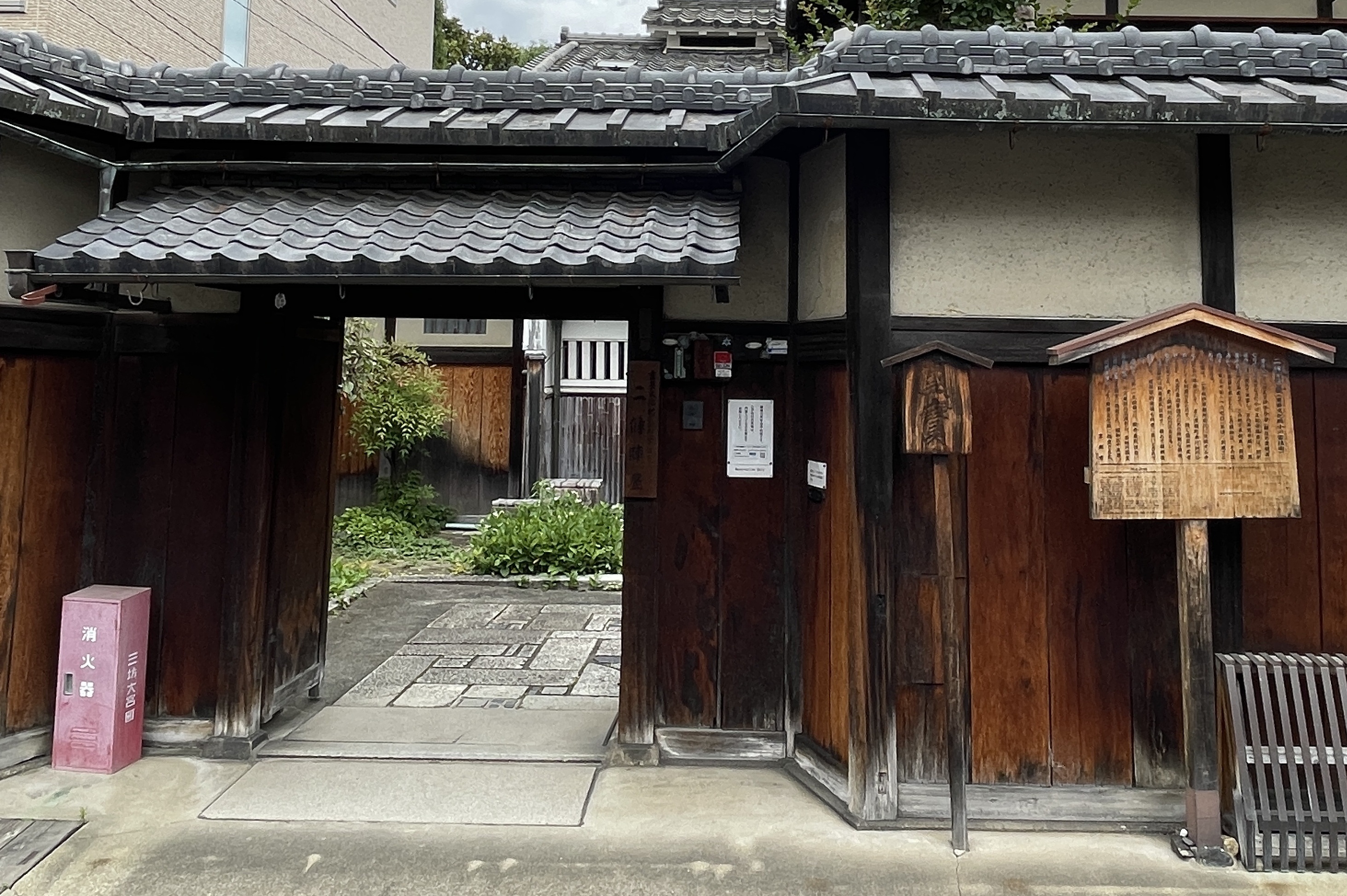
Located along Omiya Street, not far from the World Heritage Site Nijo Castle, stands the impressive townhouse "Nijo Jinya (Ogawa Family Residence)" amidst the bustling streets.
Despite being a nationally designated important cultural property, it remains a living, active residence. With a depth many times greater than its frontage, the house has the quintessential appearance of a Kyoto townhouse.
Beyond the door lies an astonishing world filled with the wisdom and ingenuity of the Edo period.
"Kuji-yado" - lodgings that provided accommodation for people coming to court.
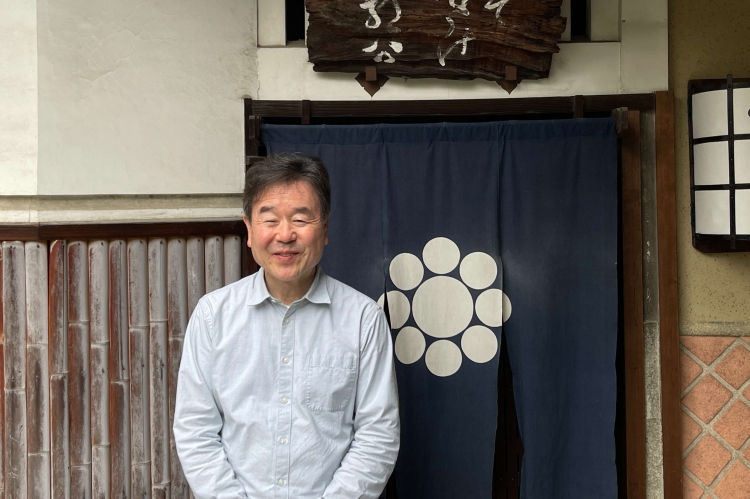
Mr. Yasuhiro Ogawa, the current head of the Nijō Jinya family.
During the Edo period, this residence was an inn called a "kuji-yado." "Kuji" was the term used at the time to refer to legal proceedings. Only those who were to be tried at the nearby Kyoto Town Magistrate's Office (an office that served as both a court and police station) were allowed to stay there.
The innkeeper played a role similar to a modern-day lawyer, such as drafting lawsuits and guiding clients on how to present evidence. While similar inns existed in Osaka (present-day Osaka City) and Edo (present-day Tokyo), this is the only one that remains in its original form.
Our guide will be the head of the family, Yasuhiro Ogawa. The residence was destroyed in a great fire in 1788 (Tenmei 8), but was rebuilt in 1849 (Kaei 2). Since then, the building, which is approximately 170 years old, has been preserved in its original form.
An unprecedented designation as a "National Treasure" saved it from demolition.
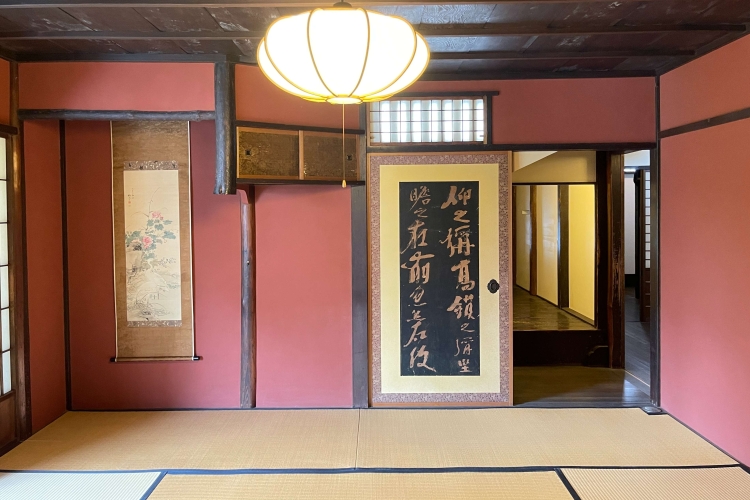
The Nijō Jinya (fortified residence) was rebuilt during the late Edo period, but during World War II, an order was issued to demolish the residence to make way for the expansion of the adjacent elementary school.
The person who stopped it was a professor of architecture from Tokyo Imperial University who used this mansion as his regular lodging in Kyoto. He said that he wanted to preserve it for future generations because of its rarity as a surviving example of a government lodging and its high architectural value, which was evident in the ingenuity of various features.
After striving to preserve the building by designating it a National Treasure, in 1944 (Showa 19), it achieved the unprecedented designation of a National Treasure, becoming only the second private residence in the country to receive this honor. Subsequently, with the enactment of the Cultural Properties Protection Law in 1950 (Showa 25), it was designated a National Important Cultural Property.
With the desire to "let everyone see our family residence, which has been designated a cultural property," we began opening it to the public with guided tours by family members about 70 years ago. The name "Nijo Jinya" was given by the head of the family at the time.
A variety of "mechanisms" designed to protect lives
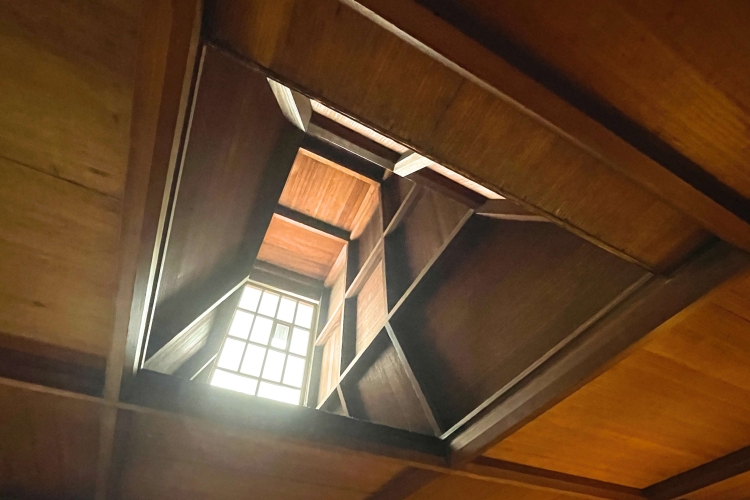
In the ceiling of the guest room, there was a "warrior's hiding place" disguised as a skylight, which was used to guard the host and guest.
The highlight of the mansion lies in the hidden mechanisms scattered throughout. There is a "hanging staircase" that normally appears as a shelf but allows escape to the second floor in case of emergency, a "warrior hiding place" where guards are stationed unnoticed by visitors, and "deceptive doors" designed to confuse pursuers. Furthermore, there is a hidden staircase leading to the roof and a skylight, allowing free movement between the roof and the interior of the mansion, providing a mechanism to escape pursuers.
In fact, it is believed that these arrangements were not only for the benefit of the guests, but also to protect the owner's own life, as he risked incurring the wrath of the opposing party by facilitating legal proceedings.
"The most interesting part is definitely the traps for hiding and escaping. After all, lives were at stake," says Mr. Ogawa. When you explore the site with the serious background in mind, the intricate traps stand out even more.
Not just mechanical devices, but also the wisdom of life in Edo.
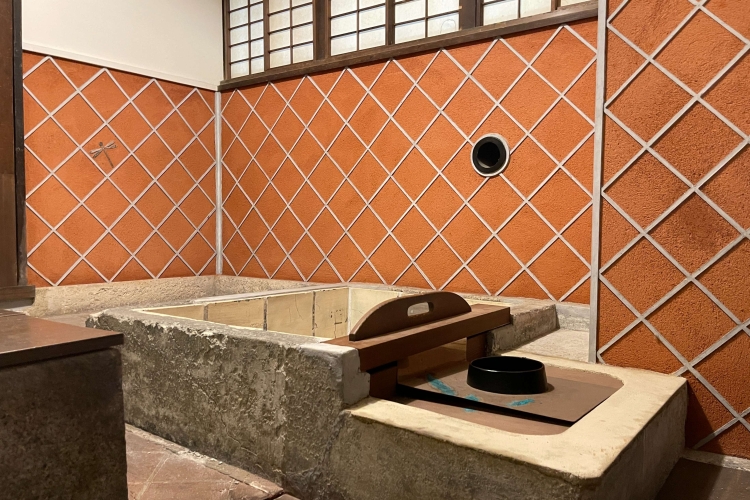
A bathtub with an iron cauldron and partition plates that allows for temperature control of the water.
Another thing Mr. Ogawa wants us to pay attention to is the wisdom of everyday life for ordinary people in the Edo period.
To protect the house from flying embers, a fire-prevention device hangs a wet straw mat from the eaves. A gourd-shaped skylight elegantly and functionally lets in natural light. An innovative bathtub with adjustable water temperature. A stage equipped with sliding doors to beautifully amplify the sound of musical instruments. The house is filled with the ingenuity of ordinary people.
As Mr. Ogawa says, "This house conveys the ingenuity and aesthetic sensibilities of the common people of the Edo period," the approximately one-hour tour is filled with unexpected discoveries and surprises.
The light streaming in through the skylight, the bathtub with its carefully controlled water temperature, and the numerous escape routes—all of these reflect the sincerity and wisdom of the people who lived through that era. A visit to this mansion during your travels will allow you to step away from your daily routine and reflect on life in the distant Edo period.
Nijō Jinya (Ogawa Family Residence)
Address: 137 Sanbo-Omiya-cho, Omiya-dori Oike-sagaru, Nakagyo-ku, Kyoto City, Kyoto Prefecture
Access: 5-minute walk from Nijojo-mae Station on the Kyoto Municipal Subway Tozai Line.
Website: https://nijyojinya.net/
*Tours are by reservation only. Please make your reservation through the reservation calendar on our official website (reservations by phone are not accepted).
*Overseas guests are required to be accompanied by a Japanese interpreter. Please arrange for an interpreting service as listed on the facility's website (https://nijyojinya.net/english/).
*For details regarding opening days and visiting hours, please check the link above.