ReservationSearch and reserve rooms
Click here to confirm, change or cancel your reservation
Flight-Inclusive Packages
Shinkansen-Inclusive Hotel Packages
Corporate Partner Reservations
2026.01.20
Create one-of-a-kind accessories from scraps. Enjoy a kintsugi (gold repair) experience in Kyoto.
NEIGHBORS
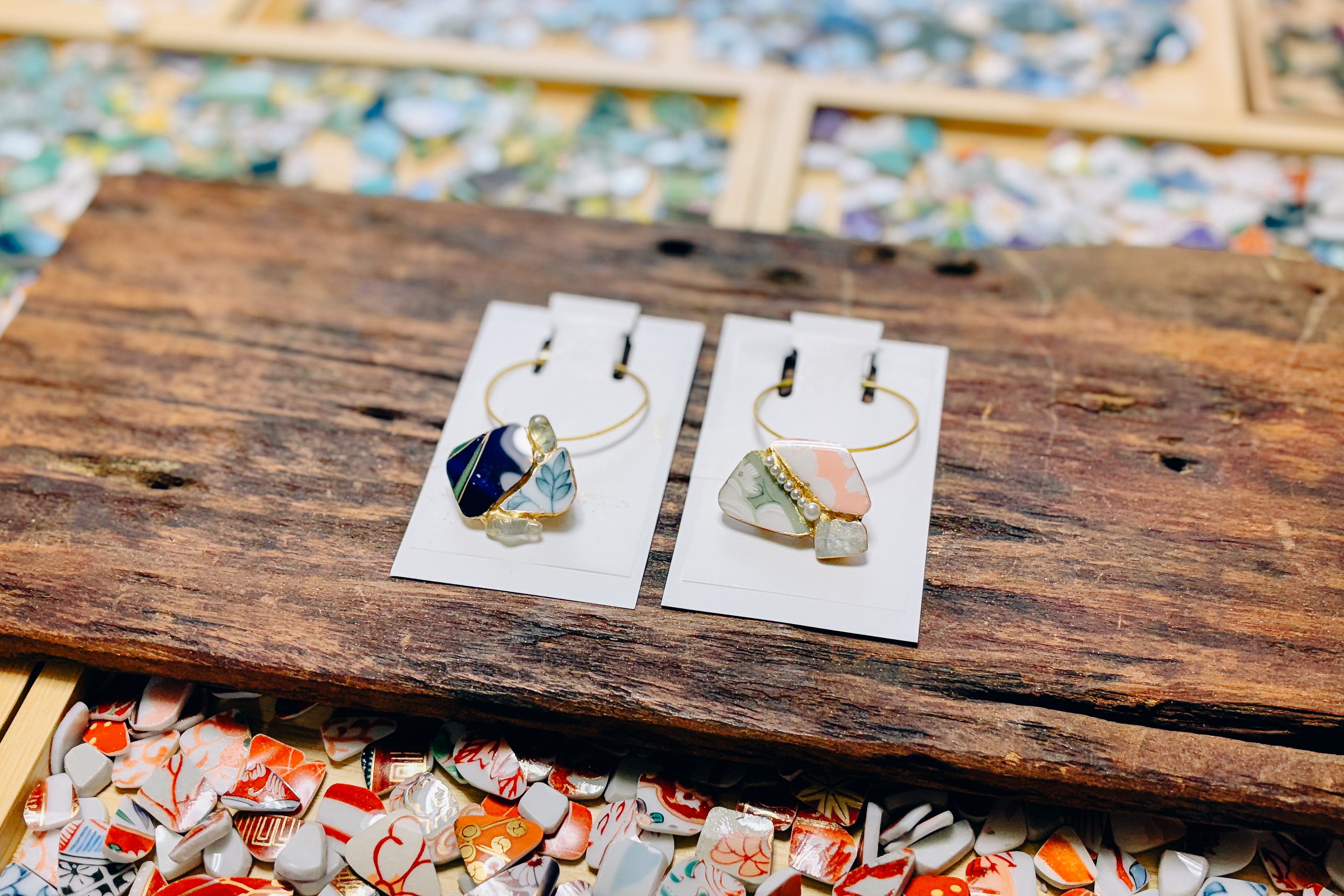
Kyoto has long flourished as a center for disseminating Japanese traditions and culture, where pottery and techniques from all over Japan gather. Even today, many people visit Kyoto seeking "experiences" where they can immerse themselves in Japanese culture.
Just a 10-minute walk from HOTEL RESOL KYOTO SHIJO MUROMACHI, there's a place where you can easily experience the "kintsugi" technique and create a one-of-a-kind accessory. That place is Kyoto Kintsugi "Karin".
Kintsugi is a traditional Japanese technique that creates new beauty by joining cracks and chips with lacquer and decorating them with gold. At "Karin," you can select small pieces of broken pottery and have them transformed into accessories such as earrings, rings, and brooches.
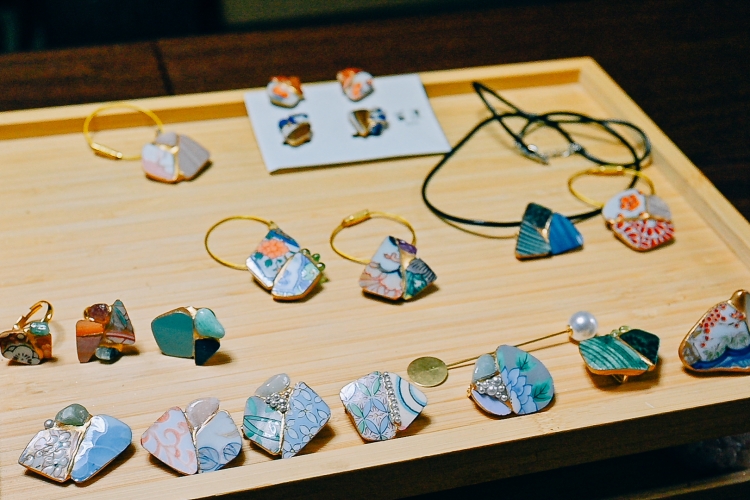
You can create your favorite item from earrings, rings, brooches, obi clips, and pendants.
Each encounter with a fragment is a once-in-a-lifetime experience.
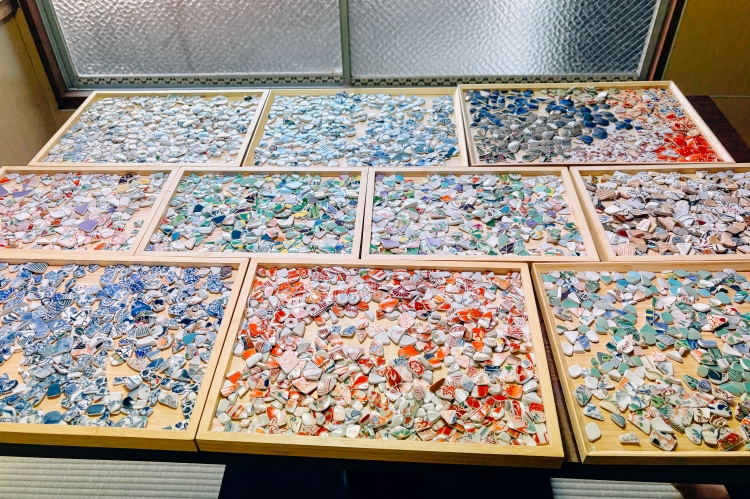
Fragments of over 300 different types, from Kiyomizu ware to Thai Benjaroni ware.
In the "Kintsugi Accessory Making Experience" offered by "Karin," you can create accessories by combining 1 to 3 pieces of pottery. There are over 300 types of pieces to choose from, with a variety of shapes, sizes, and patterns.
"No two pieces are exactly alike; each one is a unique, once-in-a-lifetime encounter that you might not find the next time you visit. First, please choose as many pieces as you like," says owner Kaori Kimura.
When a vessel is broken into tiny pieces, it cannot be repaired and restored to its original form using the kintsugi technique. "Karin" collects such broken antiques and fragments of vessels that were misfired in Kiyomizu ware workshops.
The shop offers a wide variety of ceramics, from Japanese pottery such as Kyo-yaki, Kutani-yaki, and Imari-yaki, to pieces from overseas, including some fragments from the Edo period. "Sometimes, when you're polishing them, they have a scent like dashi broth," Kimura smiles.
The presence of lacquer, which is indispensable for kintsugi (gold repair).
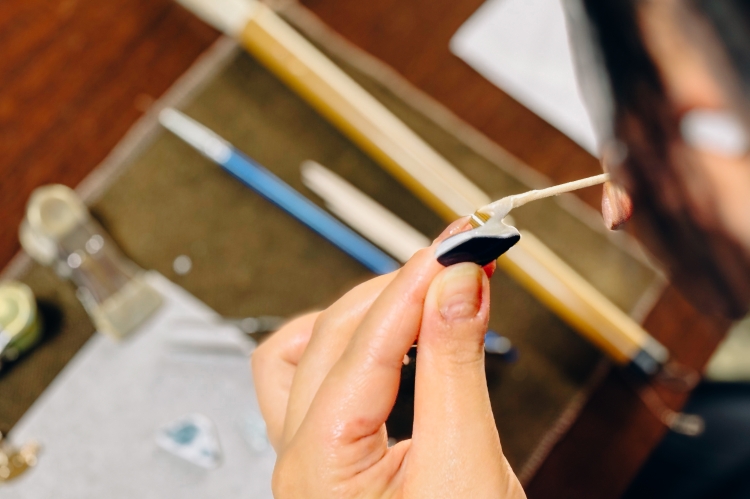
Apply lacquer to the cross-section of the selected piece.
After selecting the pieces, you decide on their orientation, arrangement, and how to connect them. Once the arrangement is decided, it's time to apply the lacquer.
Lacquer has been used as a natural paint and adhesive since the Jomon period. It takes about 10 years for a lacquer tree, carefully nurtured by craftsmen from the time it is a sprout, to become mature enough to harvest sap. Even by making incisions in the tree and scraping off small amounts at a time, repeating the process every four days or so, only about 300 grams of sap can be harvested in four months. The workshop will allow you to learn about the history and background of lacquer.
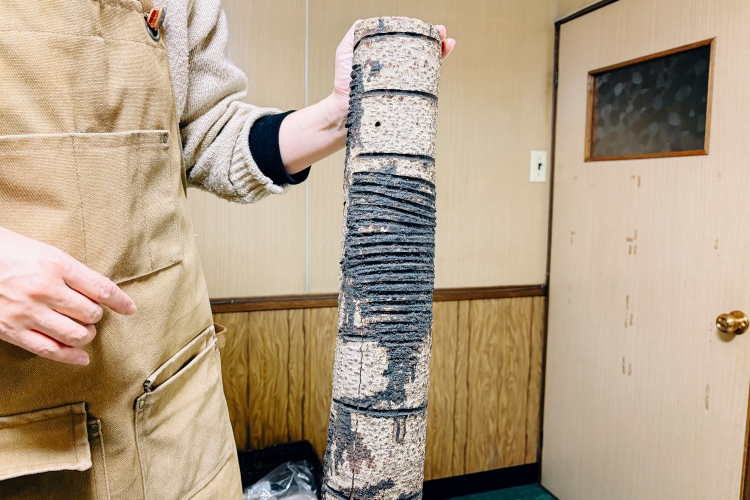
Lacquer tree from Fukuchiyama, Kyoto
At "Karin," they use "cashew lacquer," a synthetic resin paint that is less likely to cause allergic reactions and is easy to handle, so that participants can safely handle lacquer during the experience. Ms. Kimura will carefully teach you how to apply it, demonstrating the process, but since the lacquer starts to harden in just a few minutes, the work naturally requires concentration. That moment is also one of the charms of this experience.
The more you use your hands, the deeper your attachment becomes.
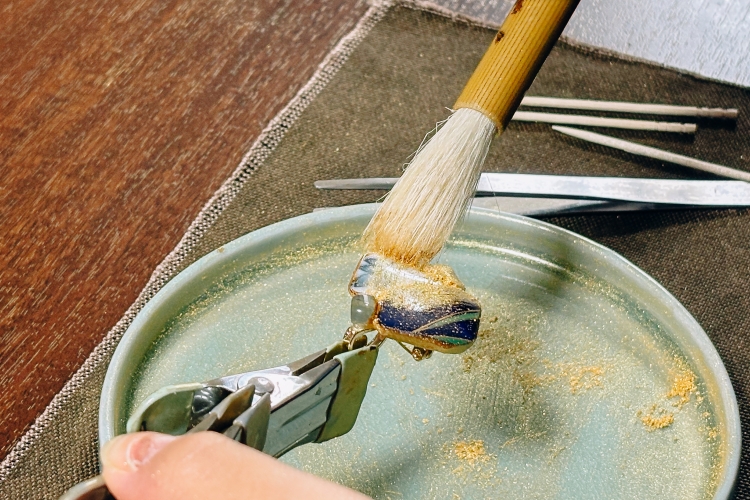
The act of sprinkling gold powder
On the areas coated with lacquer, a mixture of lacquer, gold powder, and thinner is applied thinly with a brush. This process is designed to make the cracks and seams of the vessel stand out beautifully as "golden lines." Since the gold powder only adheres to the areas coated with lacquer, the powder is spread by tracing over the surface with the brush while dropping small amounts of powder at a time.
The trick is to apply a thin, even layer, as applying it too thickly will cause the gold powder to sink. By carefully applying the gold powder not only to the joints between the pieces but also to the back and sides, the piece will look beautiful from any angle.
Many people initially feel unsure about whether they can do it well, but as they get closer to completion, they grow attached to their creations and want to show them off, saying, "Isn't it cute?"
The finished accessories are carefully wrapped by Ms. Kimura, so you can take them home after the experience. They can be used after drying for about two days and rinsing with water, which is great because you can start using them right away during your trip or when you return from your trip.
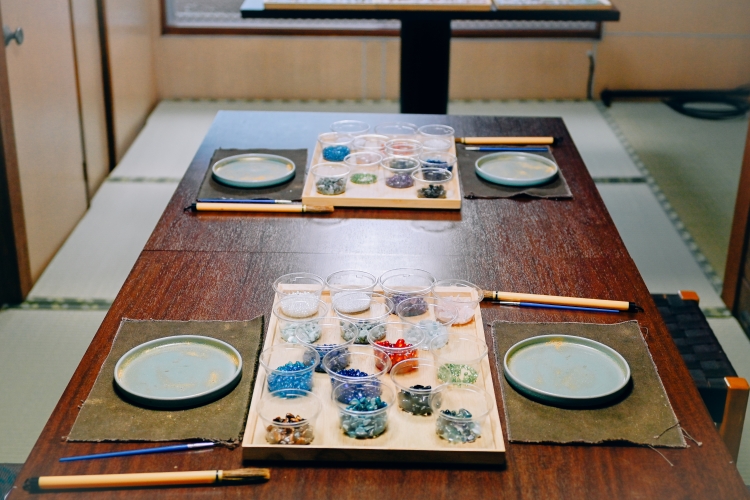
You can have this experience in a traditional Kyoto townhouse.
Ms. Kimura, who studied dyeing during her student days and has been familiar with Japanese culture and traditional crafts, discovered kintsugi (gold repair) when a teacup she cherished broke.
Afterward, she seriously studied Kintsugi (the art of repairing broken pottery with gold) and opened a shop in Kyoto, a city where Japanese culture and traditional crafts thrive. Having been familiar with Kyoto since her student days, Ms. Kimura says, "I couldn't imagine anywhere else." She chose this location as a place to share the charm of Kintsugi.
The appeal of Kintsugi lies not only in repairing broken objects, but also in reconnecting the memories that reside within them.
She once had a coral accessory, a memento from her mother, remade into an obi clasp. The design was a little outdated, and she rarely had the opportunity to wear it, but by turning it into an obi clasp, she was able to wear it when she wore a kimono, and she was very happy about it.
"I was nervous about taking on a memento, but I learned that it can also connect us to memories and bonds with that important person," Kimura said. Her words convey that she cherishes not only the object itself, but also the memories behind it.
I want to bring back a tangible memory of the time I spent in Kyoto.
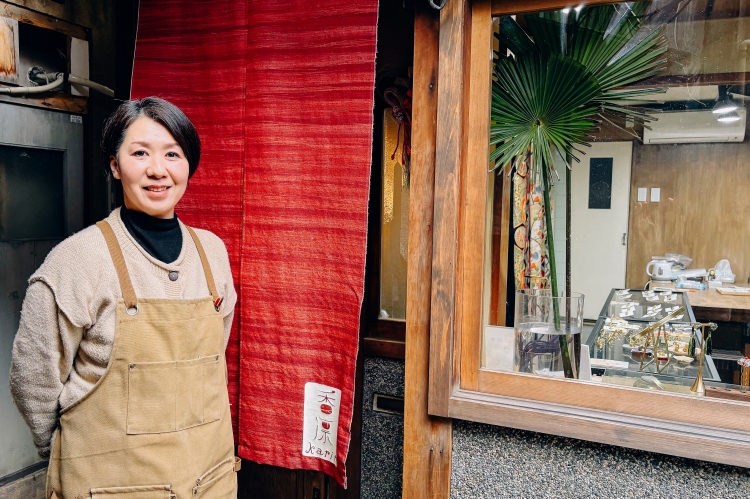
Ms. Kimura, owner of "Karin"
When asked what inspired her to apply the technique to accessories, Kimura said, "Of course, plates are beautiful as they are. But even a single broken piece is cute. It's a shame when they break into small pieces and become unusable, but if you reshape them, they can be used for a long time again."
Many visitors to "Karin" leave with satisfied expressions on their faces after seeing their finished artwork. There are many repeat visitors, and the number of visitors from overseas is also increasing.
This is a place where you can capture memories of your travels, create gifts for loved ones, and take home your time in Kyoto in a way that is uniquely yours.
香凛
電話:090-9692-0990
住所:京都府京都市下京区塗師屋町92-3
アクセス:阪急「河原町駅」より徒歩5分、地下鉄東西線「烏丸駅」より徒歩5分
HP:https://kyotoice.wixsite.com/my-site-6
SNS:https://www.instagram.com/karin_kyokintsugi/
*営業時間や定休日についての詳細は、上記のリンク先からご確認ください。