ReservationSearch and reserve rooms
Click here to confirm, change or cancel your reservation
Flight-Inclusive Packages
Shinkansen-Inclusive Hotel Packages
Corporate Partner Reservations
2026.08.20
Takesasado, a Kyoto woodblock printing shop, thrives on a cobblestone street.
NEIGHBORS
Heading west along Muromachi Street, which once flourished as a district of kimono merchants, you'll find Koyaku-no-zushi, a cobblestone alley connecting Shijo Street and Ayakoji Street. This charming corner is said to derive its name from the Kuya Kuyo, a memorial service held by the Heian period monk Kuya for the spirit of Taira no Masakado.
In this quiet alleyway, a stark contrast to the hustle and bustle of the downtown area, lies Takezasado, a workshop and shop housed in a traditional Kyoto townhouse.
Takesasado, which originated from Takenaka Mokuhan, a woodblock printing workshop founded in 1891 (Meiji 24), was established by the 5th generation owner, Kenji Takenaka, when the environment changed with the rise of machine printing. He took the lead in opening a shop, developing original products, and bringing the carving process in-house. To this day, they continue to carry on the tradition of hand-printed woodblock printing.
The history of "Kyoto printmaking" nurtured in Kyoto
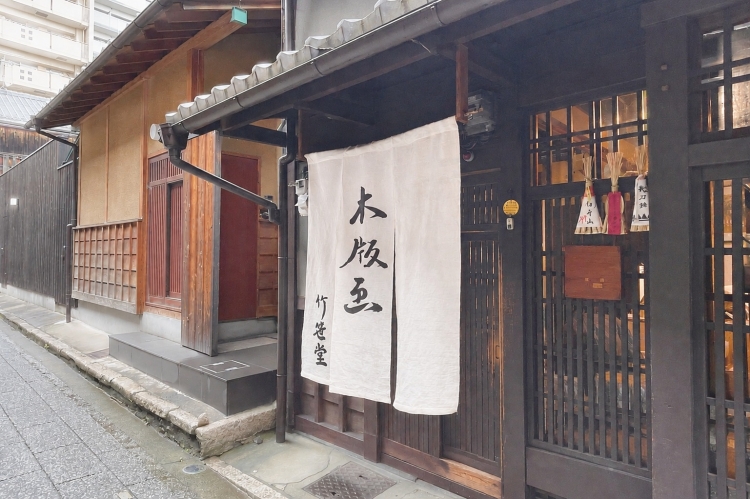
Takesasado is a workshop housed in a traditional Kyoto townhouse built during the Meiji period.
Woodblock printing is considered one of the world's oldest printing techniques, originating with the introduction of Buddhism and the printing of Buddhist scriptures. This same technique flourished in both Edo (Tokyo) and Kyoto.
While ukiyo-e prints flourished in Edo as entertainment for the common people, in Kyoto, prints expanded into a diverse range of forms, including prints for the Imperial Palace, fans, patterns for Nishijin weaving, and even wrapping paper for Japanese sweets, all linked to crafts and publishing. This is known as "Kyoto prints."
The materials and tools were not significantly different from those in Edo, and there was even exchange among the printers. However, while ukiyo-e prints were characterized by their firm printing technique, Kyoto prints are characterized by a soft application of color without rubbing the paper. The accumulation of delicate techniques, honed over many years to suit a wide variety of products, supports the unique expression of Kyoto prints.
A rare workshop where carving and printing coexist.
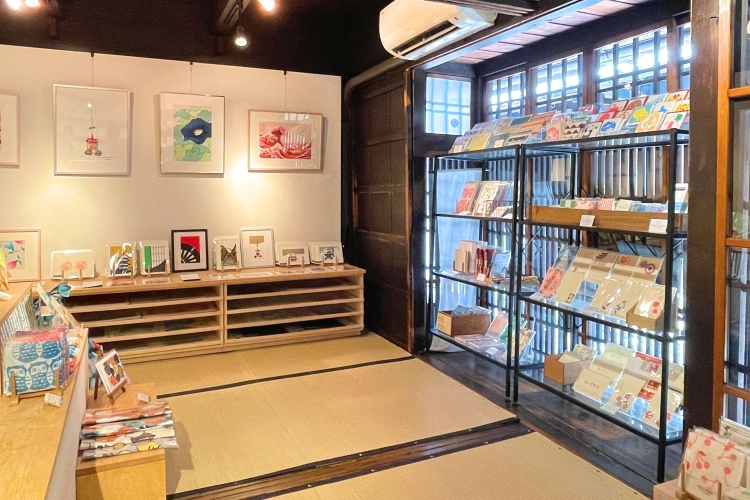
The shop has a tatami-matted floor. You can take off your shoes and take your time to find your favorite item.
Woodblock printing is a world of division of labor, involving a "publisher" who plans and sells the designs, an "artist" who draws the pictures, a "carver" who carves the woodblocks, and a "printer" who does the printing. However, Takesasado is a rare workshop that employs both printers and carvers under the same roof. This allows for immediate communication such as "I'd like it carved a little more like this" or "I want it printed like this," resulting in higher precision in the production process.
The printing is handled by the 6th generation Harada Yuko. Originally from Kagoshima Prefecture, her motivation for becoming a woodblock printer stemmed from the joy she experienced with woodblock printing during elementary school classes.
Driven by a desire to work in the arts and study in Kyoto, Harada enrolled in Kyoto University of Education. While searching for tools to teach woodblock printing during her teaching practice, she met the fifth-generation Takenaka. Harada then became Takenaka's apprentice and has since been involved in a wide range of activities, from printing and design to teaching classes, for over 20 years.
Learning the printing process by hand
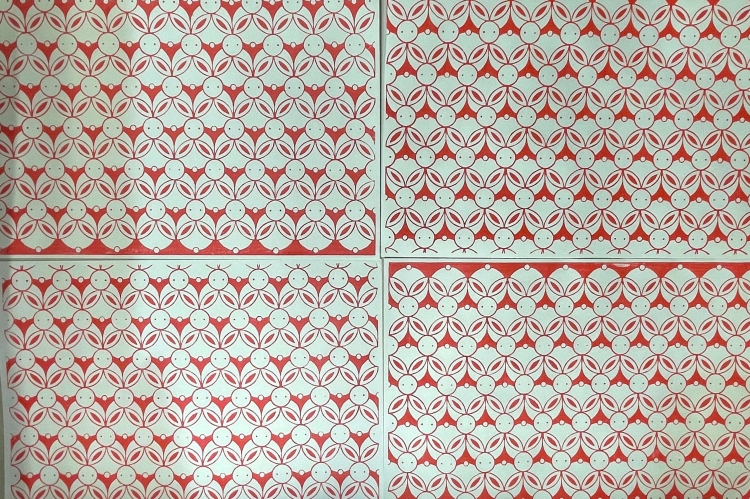
A freshly made "bunny chain"
Printing in the workshop is the "Rabbit Connection" book cover designed by Harada. The design of rabbits in a chain symbolizes the wish for connections and relationships to be formed.
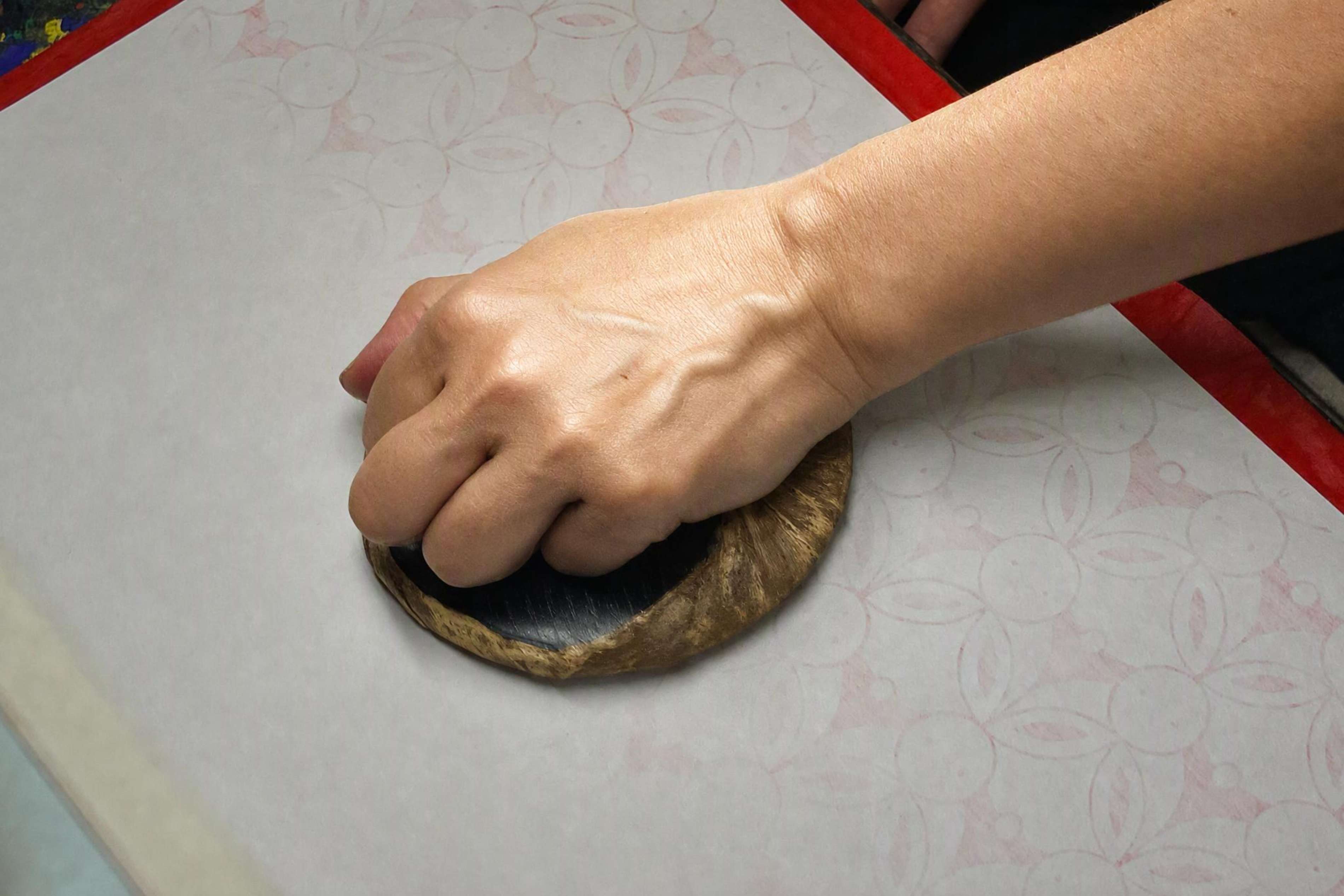
The difficulty of hand-printing lies in consistently printing each sheet with the same quality. The key to this is the moisture level of the paper. In woodblock printing, colors are layered onto damp Japanese paper, but the paper expands and contracts depending on the humidity, and even a slight drying can cause the image to shift. That's why it's necessary to remember the initial moisture level by feel and maintain that same state until the very last sheet.
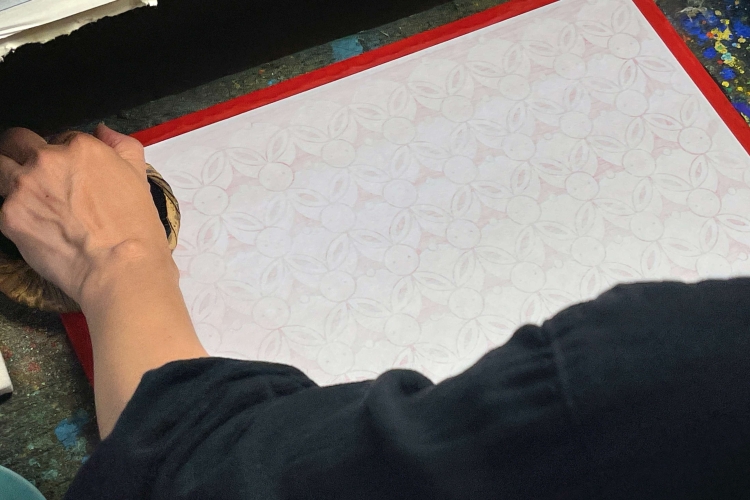
The "printing" process involves carefully printing each sheet one by one while moving the baren (printing tool) in small increments.
Harada likens this to the art of cooking. Even if you measure the ingredients, adjusting and finishing the dish requires a sense of intuition gained through experience. Moreover, because Takesasado is a workshop that handles a wide variety of products, he says it's necessary to have a large repertoire of techniques, each with its own unique characteristics, such as fans and wrapping paper.
The warmth of the handrail, and what lies ahead
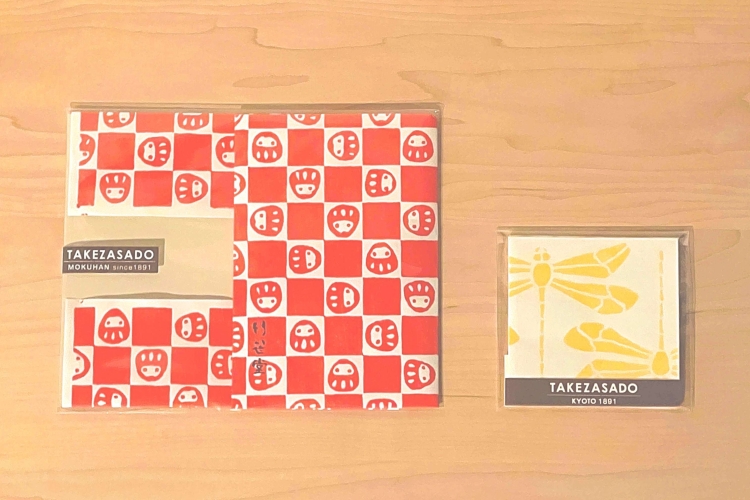
A wide variety of items perfect as souvenirs from your Kyoto trip are available, including book covers and small envelopes.
The charm of hand-printed artwork lies in the texture of the paint "sitting" on the paper. The subtle three-dimensionality and exquisite shading are palpable when you hold it in your hands. Even with the same design, there's a warmth to it that simply cannot be replicated by printing.
In addition to selling original book covers and small envelopes, Takesasado also receives many requests for the restoration and reprinting of old woodblocks that lie dormant in shrines and temples, thus playing a quiet role in supporting Japanese culture.
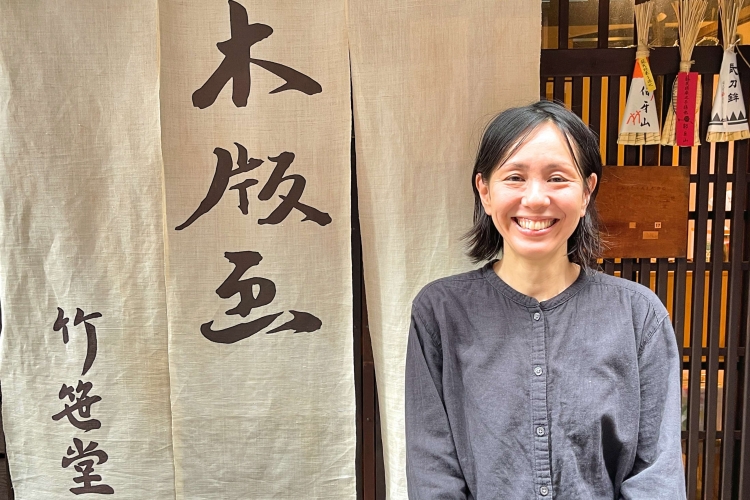
"I want to incorporate the traditional crafts that Kyoto has nurtured into my own work," says Harada.
Harada's vision is for the future of design. "I want to draw inspiration from all kinds of crafts, such as dyeing, weaving, pottery, and lacquerware, to learn about arrangement and layering of colors, and apply that to my woodblock prints," he says.
From expensive works to affordable book covers, the appeal of woodblock printing is conveyed in every field. You can experience the charm of such handcrafted work at the workshop, which is within walking distance from the hotel.
竹笹堂
電話:075-353-8585
住所:京都府京都市下京区綾小路通西洞院東入ル新釜座町737
アクセス:阪急京都線烏丸駅から徒歩8分/京都市営地下鉄四条駅から徒歩8分
HP:https://takezasado.com/
SNS:https://www.instagram.com/takezasado.shop/
*営業時間や定休日についての詳細は、上記のリンクからご確認ください。